My Untitled Site
### Genetic Engineering
- Genetic engineering is the direct manipulation of an organism's genes using biotechnology.
- Two uses include the development of genetically modified crops for improved yield and resistance to pests, and the production of insulin and other medications through recombinant DNA technology.
- Risks include potential unintended effects on non-target organisms and the environment, and the risk of creating antibiotic resistance or unforeseen health impacts in humans.### DNA and Chromosomes
- Deoxyribonucleic acid (DNA) is a molecule that carries genetic instructions / code ; chromosomes are structures made of DNA and proteins containing genetic information; genes are segments of DNA that contain instructions for making proteins
- DNA is found in the nucleus of most cells, with small amounts in mitochondria.
- DNA stores and transmits genetic information necessary for growth, development, reproduction, and functioning of living organisms.
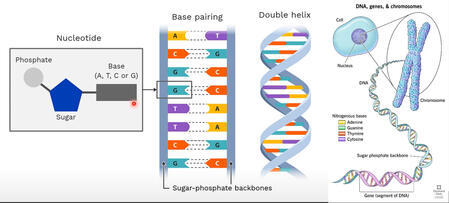
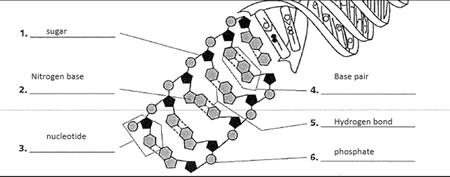
- The structure of DNA is a double helix. The backbone (two sides of the ladder) is made up of alternating sugar and phosphate molecules. Nitrogen bases are attached to the sugar molecules (like the rungs of the ladder). Hydrogen bond between adjacent bases hold the two strands together. The building blocks of the dna are called nucleotides (sub units)
-Nucleotide > Gene > Chromosome > DNA (smallest 2 largest)
- A nucleotide consists of a phosphate, a (deoxyribose) sugar, and a nitrogen base (A,C,T,G). They are all chemically bonded together
### Cell Division
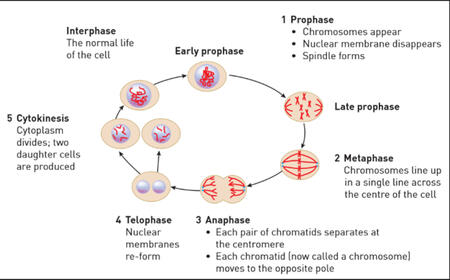
- Mitosis is cell division that does not change the number of chromosomes (per cell), used for growth and repair, it is the division of genetic material to produce two identical nuclei, it results in two diploid cells (two sets of genetic info, one from the dad, one from the mum). the cell divides in two (cytokinesis), to make two new, genetically identical daughter cells (in total there is only one division). Somatic cells undergo Mitosis (all cells in the body apart from gametes)
- Meiosis is cell division that halves the number of chromosomes used for producing gametes, it is a sex cell. Two haploid gametes combine to produce the first diploid cell of a new organism. Gamete cells undergo Meiosis (sperm and egg cells). The results are haploid with four non identical daughter cells. They only have one set of genetic info which is a combination of the mum and dad. In total two division occur.
- Somatic cells are Diploid cells (they have two sets of chromosomes (2n)) while gametes are haploid reproductive cells that have one set (n).
- Gamete cells are haploid and hold half the usual number of cells (23, somatic cells are diploid and hold 46.
- The stages of meiosis I include Interphase, prophase I, metaphase I, anaphase I, telophase I, and Cytokinesis I. Meiosis II stages are prophase II, metaphase II, anaphase II, telophase II, and Cytokinesis II.
- In meiosis I, homologous chromosomes are separated; in meiosis II, sister chromatids are separated.
Mitosis:
• Interphase: Cell duplicates its DNA, so it has 46 pairs of sister chromatids (duplicated chromosomes).
• Prophase: Chromosomes condense, and spindle fibers form.
• Metaphase: Chromosomes align at the center, and spindle fibers attach.
• Anaphase: Sister chromatids are pulled apart to opposite sides.
• Telophase: Two nuclei form around the separated chromosomes.
• Cytokinesis: The cell divides, resulting in two identical daughter cells, each with 46 chromosomes.Meiosis I:
• Interphase: Prior to meiosis, DNA is duplicated, 46 chromatids are duplicated to 96 sister chromatids, joined at the centromere, forming 46 chromosomes
• Prophase I: Chromosomes tightly coil and become visible, sister chromatids are joined together at the centromere. Recombination of chromosomes occur where parts of the chromosomes are swapped over (sometimes).
• Metaphase I: Chromosomes line up in the middle of the cell in pairs
• Anaphase I: Whole chromosomes are pulled across to opposite poles (23 chromosomes move to each side (46 chromatids))
• Telophase I & Cytokinesis: Nuclear membranes form around each set of chromosomes. Cytoplasm divides to form two non-identical cells
Meiosis II: No interphase in Meiosis II, no DNA is duplicated.
• Prophase II: Same as Prophase I, chromosomes tightly coil and become visible
• Metaphase II: Chromosomes line up in the middle of the cell, no longer in pairs and no recombination
• Anaphase II: Chromosomes are pulled apart at the centromere. Individual chromatids (1 half of the chromosome) move to each pole, so 23 chromatids to each pole
• Telophase II & Cytokinesis: Nuclear membranes form around each set of chromatids. Cytoplasm divides to form four non-identical cells. 23 chromatids become the 23 chromosomes in each cell.
### Fertilization and Sex Determination
- Fertilization is the process where a sperm cell and an egg cell unite to form a zygote. The sperm enters the ovum, and the two haploid cells fuse together, combining the two sets of chromosomes and forming the diploid zygote, which will go on to develop into an embryo with many different types of cells.
- The sex of an offspring is found out by the combination of sex chromosomes given by the parents, with the father determining the sex. Gametes carry only one copy of the sex chromosomes. Sperm can have X or Y, Ova can only have X.
- Sex chromosomes determine the sex of an individual as well as sex related traits (humans have 1 pair of them, XX (female), or XY (male))
- Making Karyotypes is known as Karyotyping, and it uses blood or bodily fluids that contain cells. Scientists will take an image of the chromosomes in the cell and rearrange them using the size and banding patterns.
- Karyotyping is useful for: Detecting chromosome abnormalities, Determining the cause of a malformation or disease, Prebirth detection of genetic diseases, Sex determination, Evolutionary relationships.
### Autosomal Inheritance
- Autosomal inheritance relates to traits inherited on the autosomal chromosomes. Humans have 22 of them
- Alleles are different forms of a gene found at the same locus on homologous chromosomes.
- An individual's genotype is their genetic makeup (e.g., homozygous or heterozygous), while the phenotype is the observable traits.
- Dominant traits mask the effect of recessive traits in heterozygous individuals.
- Combinations of dominant and recessive alleles produce different genotypes (e.g., homozygous dominant, heterozygous, homozygous recessive) and phenotypes (observable traits).
### Pedigrees
- A pedigree is a diagram that shows the occurrence and appearance of phenotypes of a particular gene or organism and its ancestors. It can be drawn using information on individuals in a family, indicating the inheritance patterns of traits.
- To determine the gender of individuals in a pedigree, males are typically represented by squares and females by circles.
- The phenotype of individuals in a pedigree can be determined by the symbols used; shaded symbols often indicate affected individuals.
- The genotype of individuals can often be inferred from the phenotype and their relationship to other individuals in the pedigree
Deoxyribonucleic acid | DNA; a molecule that carries the genetic instructions used in the growth, development, and reproduction of living organisms.
Nucleotide | The basic building block of DNA, consisting of a sugar, a phosphate group, and a nitrogenous base.
Chromosome | A thread-like structure made of DNA and proteins that contains genetic information.
Gene | A segment of DNA that codes for a specific trait or protein.
Complementary bases | Pairs of nitrogenous bases that bond together in DNA: adenine with thymine, and cytosine with guanine.
Karyotype | A visual representation of an organism’s complete set of chromosomes.
Mitosis | A type of cell division where a single cell divides to produce two identical daughter cells for growth and repair.
Meiosis | A type of cell division that produces gametes (sperm and egg cells), reducing the chromosome number by half.
Gamete | A reproductive cell (sperm in males, ovum in females) that carries half the genetic information of an organism.
Somatic cell | Any body cell that is not a gamete; contains a full set of chromosomes.
Germ cell | A cell that gives rise to gametes through meiosis.
Diploid number | The total number of chromosomes in a somatic cell, which includes two sets of chromosomes, one from each parent.
Haploid number | The number of chromosomes in a gamete, which is half the diploid number.
Fertilisation | The process where a sperm cell and an ovum merge to form a zygote, the first cell of a new organism.
Sperm | The male gamete that carries half the genetic information needed for reproduction.
Ovum | The female gamete that also carries half the genetic information required for reproduction.
Zygote | The cell formed after fertilisation, containing a complete set of chromosomes from both parents.
Allele | A variant form of a gene that can produce different traits.
Autosome | Any chromosome that is not a sex chromosome; these are numbered and appear in pairs in somatic cells.
Carrier | An individual who has one copy of a recessive allele that doesn’t show in their phenotype but can be passed on to offspring.
Dominant trait | A trait that is expressed in an individual even if only one copy of the allele is present.
Genotype | The genetic makeup of an organism, consisting of the alleles inherited from both parents.
Heterozygous | Having two different alleles for a specific gene.
Homozygous | Having two identical alleles for a specific gene.
Phenotype | The observable characteristics or traits of an organism, influenced by its genotype.
Punnett square | A diagram used to predict the possible genotypes of offspring from two parents.
Recessive trait | A trait that only shows when both copies of the gene have the recessive allele.
Sex chromosome | Chromosomes that determine an organism’s biological sex (X and Y chromosomes in humans).